
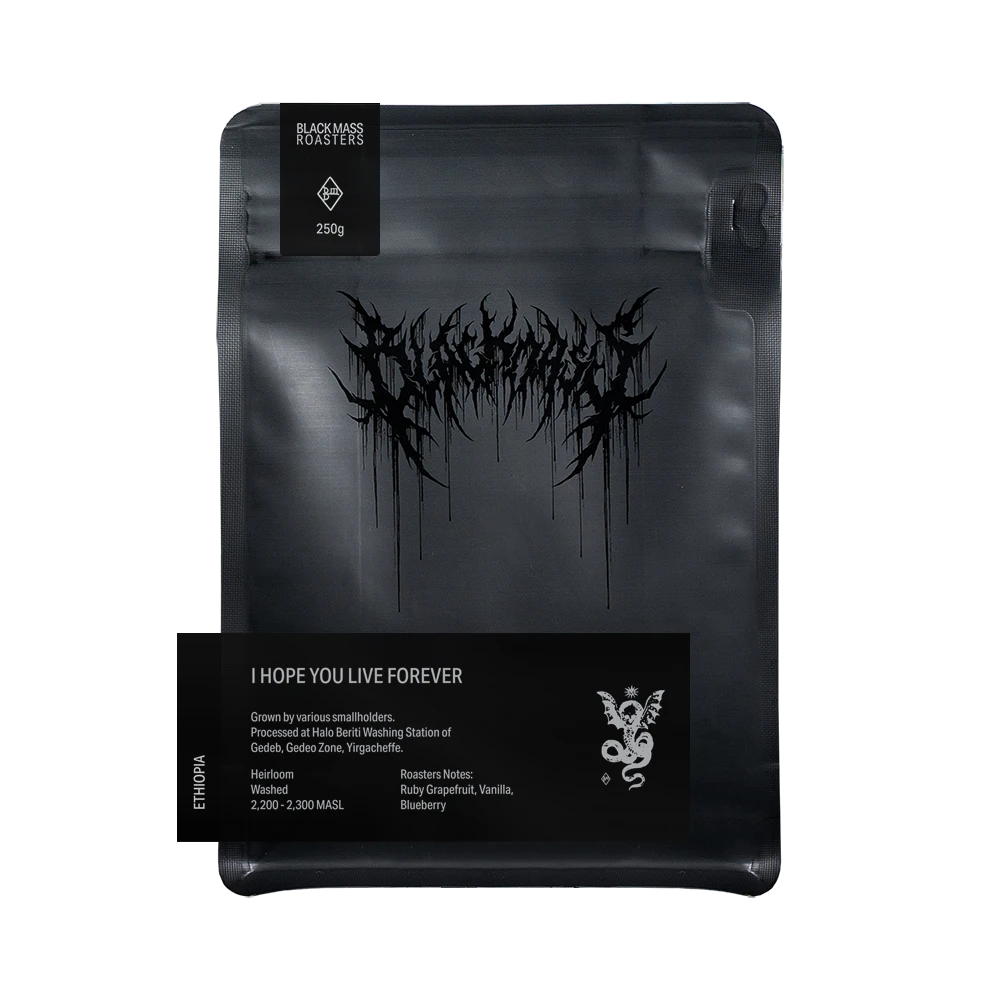
I HOPE YOU LIVE FOREVER, Ethiopia
Ruby Grapefruit, Vanilla, Blueberry
Suitable for all brewing methods.
Roasters Notes: Ruby Grapefruit, Vanilla, Blueberry
| Producer | Various smallholders of Gedeb |
| Washing Station | Halo Beriti Washing Station |
| Region | Gedeb, Gedeo Zone, Yirgacheffe |
| Varietal | Heirloom |
| Processing | Washed |
| Altitude | 2,200 - 2,300 MASL |
Gedeb lies in the Gedeo Zone at the southern reach of Yirgacheffe, and Halo Beriti sits within it on 4.8 hectares of ground laid directly beside a river. The trees that feed the station grow under native shade, Birbira and Acacia standing over the plots, and the cherry for this lot is taken between 2,200 - 2,300 MASL. Altitude of that order is not decoration on a label. It slows ripening to a crawl and thickens the cell walls, leaving a seed of high density and uniform screen, which is what allows a station of this size to hold one grade across a harvest gathered from a thousand separate hands.
The station is run by Boledu Coffee, founded in 2017 by Abeyot Ageze and Mebrahtu Aynalem, with Halo Beriti among the first sites they took on. More than a thousand smallholders deliver to it each season. Most work around two hectares, ground inherited rather than bought, coffee standing in the same fields as the family's food crops and the labour shared out across the household. Where a producer's cherry stands apart it is kept apart, processed as its own lot and paid at a premium. A station assembling a harvest from that many hands lives or dies on what it turns away at intake, and this one turns away a great deal.
The planting is heirloom, which at Halo Beriti means Wolisho and Dega, the two Yirgacheffe landraces that have held this ground for generations. Cherry is pulped on arrival and left to ferment in tank for 48 - 72hrs, the window set by the ambient temperature rather than the clock, long enough to break the mucilage off the parchment without letting the ferment run past itself. It is washed out through grading channels, where water sorts by density and carries the heavier seed apart from the light. From there it goes onto raised beds, 220 of them, near twice the capacity of neighbouring Halo Hartume, and dries for 10 - 12 days, turned by hand and sorted at every pass. Washing leaves no veil over the seed. What survives it is the variety, the altitude, and the discipline of the station that handled it.
What comes off the beds is rested, hulled, graded and hand sorted again before it is bagged for export.
Choose options